Author: openx_editor

  • Cursor’s Secret Foundation: Why the $29B Coding Tool Chose a Chinese AI Over Western Open Models

    Cursor’s Secret Foundation: Why the $29B Coding Tool Chose a Chinese AI Over Western Open Models

    When Cursor launched Composer 2 last week, calling it “frontier-level coding intelligence,” the company presented it as evidence of serious AI research capability — not just a polished interface bolted onto someone else’s foundation model. Within hours, that narrative had a crack in it. A developer on X traced Composer 2’s API traffic and found the model ID in plain sight: Kimi K2.5, an open-weight model from Moonshot AI, the Chinese startup backed by Alibaba, Tencent, and HongShan (formerly Sequoia China).

    Cursor’s leadership acknowledged the oversight quickly. VP of Developer Education Lee Robinson confirmed the Kimi connection, and co-founder Aman Sanger called it a mistake not to disclose the base model from the start. But as a VentureBeat investigation revealed, the more important story is not about disclosure — it is about why Cursor, and potentially many other Western AI product companies, keep reaching for Chinese open-weight models when building frontier-class products.

    What Kimi K2.5 Actually Is

    Kimi K2.5 is a beast of a model, even by the standards of the current AI arms race:

    • 1 trillion parameters with a Mixture-of-Experts (MoE) architecture
    • 32 billion active parameters at any given moment
    • 256,000-token context window — handling massive codebases in a single context
    • Native image and video support
    • Agent Swarm capability: up to 100 parallel sub-agents simultaneously
    • A modified MIT license that permits commercial use
    • First place on MathVista at release, competitive on agentic benchmarks

    For a company like Cursor building a coding agent that needs to maintain structural coherence across enormous contexts — managing thousands of lines of code, multiple files, and complex dependencies — the raw cognitive mass of Kimi K2.5 is hard to replicate.

    The Western Open-Model Gap

    The uncomfortable truth that Cursor’s situation exposes is that as of March 2026, the most capable, most permissively licensed open-weight foundations disproportionately come from Chinese labs. Consider the alternatives Cursor could have theoretically used:

    • Meta’s Llama 4: The much-anticipated Llama 4 Behemoth — a 2-trillion-parameter model — is indefinitely delayed with no public release date. Llama 4 Scout and Maverick shipped in April 2025 but were widely seen as underwhelming.
    • Google’s Gemma 3: Tops out at 27 billion parameters. Excellent for edge deployment but not a frontier-class foundation for building production coding agents.
    • OpenAI’s GPT-OSS: Released in August 2025 in 20B and 120B variants. But it is a sparse MoE that activates only 5.1 billion parameters per token. For general reasoning this is an efficiency win. For Composer 2, which needs to maintain coherent context across 256K tokens during complex autonomous coding tasks, that sparsity becomes a liability.

    The real issue with GPT-OSS, according to developer community chatter, is “post-training brittleness” — models that perform brilliantly out of the box but degrade rapidly under the kind of aggressive reinforcement learning and continued training that Cursor applied to build Composer 2.

    What Cursor Actually Built

    Cursor is not just running Kimi K2.5 through a wrapper. Lee Robinson stated that roughly 75% of the total compute for Composer 2 came from Cursor’s own continued training work — only 25% from the Kimi base. Their technical blog post describes a proprietary technique called self-summarization that solves one of the hardest problems in agentic coding: context overflow during long-running tasks.

    When an AI coding agent works on complex, multi-step problems, it generates far more context than any model can hold in memory. The typical workaround — truncating old context or using a separate model to summarize it — causes critical information loss and cascading errors. Cursor’s self-summarization approach keeps the agent coherent over arbitrarily long coding sessions, enabling it to tackle projects like compiling the original Doom for a MIPS architecture without the model’s core logic collapsing.

    Cursor patched the debug proxy vulnerability that exposed the Kimi connection within hours of it being reported. But the underlying question remains: if you are building a serious AI product in 2026 and you need an open, customizable, frontier-class foundation model, where do you turn?

    The Implications for Western AI Strategy

    Cursor is not an outlier. Any enterprise building specialized AI applications on open models today faces the same calculus. The most capable options with the most permissive licenses — models from Moonshot (Kimi), DeepSeek, Alibaba (Qwen), and others — all come from Chinese labs. This is not a political statement; it is a technical and commercial reality that Western AI strategy has yet to fully address.

    The open-source AI movement, which many hoped would democratize AI development and reduce dependence on any single company or country, has a geography problem. And Cursor’s Composer 2 episode has made it visible in a way that is difficult to ignore.

    Whether this represents a crisis for Western AI competitiveness or simply a new era of globally distributed AI innovation depends entirely on your perspective. But if the current trajectory holds, the next generation of powerful open AI tools — coding agents, research assistants, autonomous systems — will be built on foundations laid in Beijing as often as in Menlo Park.

    Read the full VentureBeat investigation at VentureBeat.

  • MoneyPrinterV2: The Open-Source AI Tool That’s Automating Online Income (And Sparking Debate)

    MoneyPrinterV2: The Open-Source AI Tool That’s Automating Online Income (And Sparking Debate)

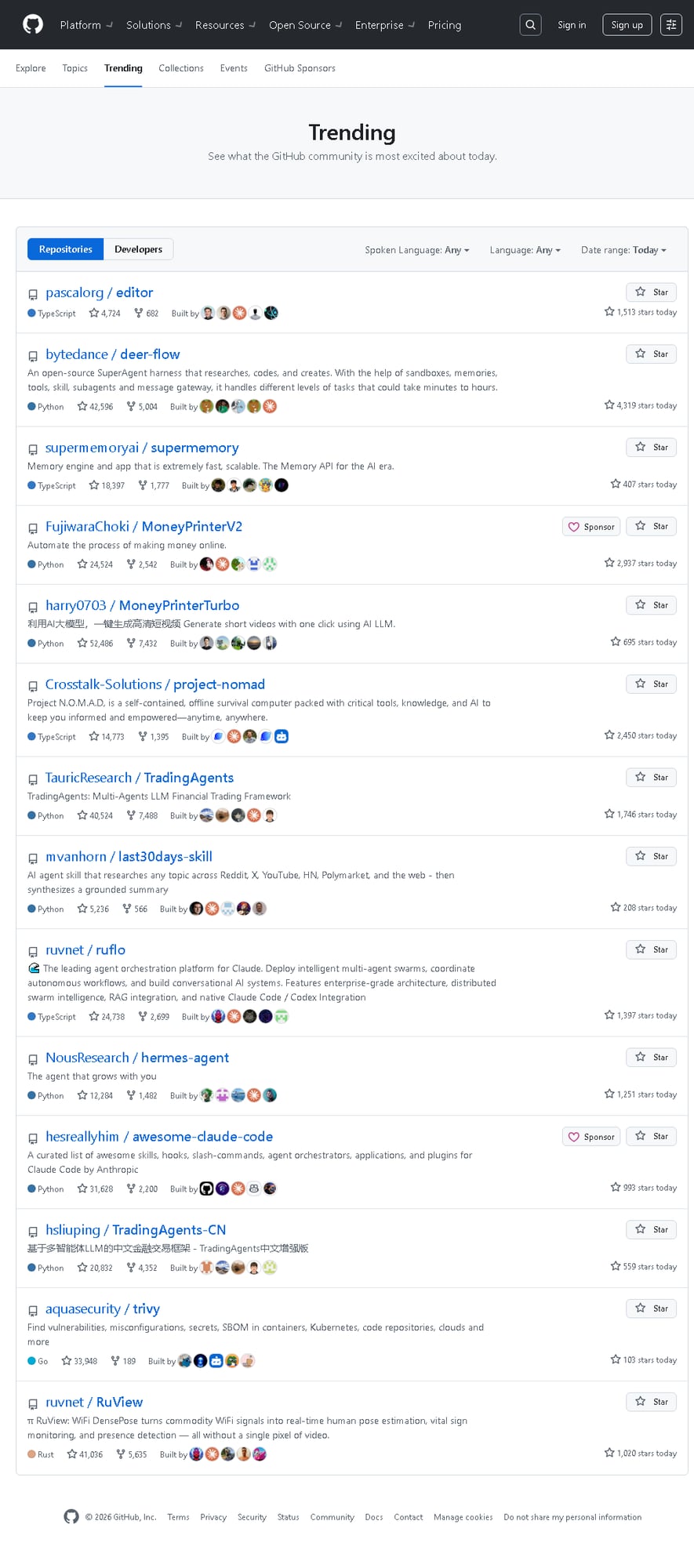
    It has nearly 25,000 GitHub stars and has earned over 2,900 stars in a single day. Love it or question it, MoneyPrinterV2 is impossible to ignore. The project, officially described as “an application that automates the process of making money online,” is one of the most talked-about open-source AI tools on GitHub right now.

    Created by developer FujiwaraChoki, MoneyPrinterV2 is a complete rewrite of the original MoneyPrinter project, built with a modular architecture and a much wider feature set. It leverages AI models — including gpt4free for text generation and KittenTTS for voice synthesis — to automate the creation and distribution of online content at scale.

    What MoneyPrinterV2 Actually Does

    The core capabilities of MoneyPrinterV2 break down into several automated workflows:

    • Twitter Bot with CRON Scheduling: Automatically generates and posts tweets on a schedule using AI. Configure your topics, tone, and posting frequency, and the bot handles content creation and publication independently.
    • YouTube Shorts Automater: Takes a text prompt or article, generates a script using AI, creates a voiceover with KittenTTS, pairs it with relevant video clips or generated visuals, and exports a formatted short video ready for YouTube Shorts. CRON job support means you can queue batches for automatic upload.
    • Affiliate Marketing Module: Connects to Amazon’s affiliate program and Twitter to identify products, generate promotional content, and post affiliate links automatically.
    • Local Business Outreach: Finds local businesses and generates cold outreach campaigns — all AI-powered.

    Under the Hood

    MoneyPrinterV2 requires Python 3.12 and is designed for straightforward installation:

    git clone https://github.com/FujiwaraChoki/MoneyPrinterV2.git
    cd MoneyPrinterV2
    cp config.example.json config.json
    # Fill out your API keys and configuration in config.json
    python -m venv venv && source venv/bin/activate
    pip install -r requirements.txt
    python src/main.py

    Advanced users can also leverage shell scripts in the /scripts directory for direct CLI access to core functionality without the web interface.

    The Controversy

    MoneyPrinterV2 exists in a gray area that the open-source AI community has not fully grappled with. On one hand, it is a genuinely impressive piece of engineering — automating video creation, content scheduling, and affiliate linking using free AI models is technically non-trivial. On the other hand, it is explicitly designed to generate scale content for commercial purposes with minimal human oversight.

    The project’s own disclaimer states:

    “This project is for educational purposes only. The author will not be responsible for any misuse of the information provided.”

    This is the same boilerplate language used by most AI tools that could theoretically be misused — and like most such disclaimers, it raises more questions than it answers. The question of whether an automated content factory at this scale is “educational” is one the community will continue to debate.

    The Community Fork: MoneyPrinterTurbo

    One sign of MoneyPrinterV2’s popularity is the emergence of community forks. The most notable is MoneyPrinterTurbo, a Chinese-language version that has also gained significant traction. The proliferation of forks in multiple languages underscores the global demand for AI-powered content automation tools.

    What the Numbers Tell Us

    With nearly 25,000 stars in what appears to be a relatively short timeframe, MoneyPrinterV2 is among the fastest-growing open-source AI projects on GitHub. The combination of AI video generation, social media automation, and affiliate marketing in a single modular application addresses a real pain point for indie creators, digital marketers, and anyone looking to generate passive income through content — even if the ethics of that automation remain debatable.

    Whether you view it as a productivity breakthrough or a warning sign about AI-generated content flooding the internet, MoneyPrinterV2 is a project worth understanding. The code is open, the features are real, and its growth trajectory suggests it is filling a genuine market demand.

    Explore the source code and documentation on GitHub.

  • Project N.O.M.A.D: The Offline AI Survival Computer That’s Quietly Winning GitHub

    Project N.O.M.A.D: The Offline AI Survival Computer That’s Quietly Winning GitHub

    Imagine a computer that works without the internet — no cloud, no servers, no connectivity required — and is packed with everything you need to survive, learn, and make decisions when civilization’s digital infrastructure goes dark. That is exactly what Project N.O.M.A.D (Novel Offline Machine for Autonomous Defense) delivers, and it is turning heads on GitHub with over 14,800 stars and climbing fast.

    Developed by Crosstalk Solutions, N.O.M.A.D is a self-contained, offline-first knowledge and AI server that runs on any Debian-based system. It orchestrates a suite of containerized tools via Docker, and its crown jewel is a fully local AI chat powered by Ollama with semantic search capabilities through Qdrant — meaning your AI assistant never phones home.

    What N.O.M.A.D Actually Does

    Think of N.O.M.A.D as the ultimate digital survival kit. Once installed, it provides:

    • AI Chat with a Private Knowledge Base: Powered by Ollama and Qdrant, with document upload and RAG (Retrieval-Augmented Generation) support. Upload your own PDFs, manuals, or reference docs and query them conversationally — entirely offline.
    • Information Library: Offline Wikipedia, medical references, survival guides, and ebooks via Kiwix. This is essentially a compressed, searchable archive of human knowledge on your hard drive.
    • Education Platform: Kolibri delivers Khan Academy courses with full progress tracking and multi-user support. Perfect for classrooms in remote areas or anyone preparing for when the grid is down.
    • Offline Maps: Downloadable regional maps via ProtoMaps, searchable and navigable without a data connection.
    • Data Tools: Encryption, encoding, hashing, and analysis tools through CyberChef — all running locally.
    • Local Note-Taking: FlatNotes provides markdown-based note capture with full offline support.
    • Hardware Benchmarking: A built-in system benchmark with a community leaderboard so you can score your hardware against other N.O.M.A.D users.

    One Command to Rule Them All

    Installation is refreshingly simple. On any Ubuntu or Debian system:

    sudo apt-get update && sudo apt-get install -y curl && curl -fsSL https://raw.githubusercontent.com/Crosstalk-Solutions/project-nomad/refs/heads/main/install/install_nomad.sh -o install_nomad.sh && sudo bash install_nomad.sh

    Once running, access the Command Center at http://localhost:8080 from any browser. No desktop environment required — it is designed to run headless as a server.

    Why This Matters More Than You Think

    In an era of increasing digital centralization, N.O.M.A.D is a quiet act of resistance. It says: what if you could have the power of modern AI — language models, semantic search, curated knowledge — without surrendering your data to a third party? The AI chat does not route through OpenAI, Anthropic, or Google. It runs entirely on your hardware using Ollama, which supports a growing library of open-weight models like Llama 3, Mistral, and Phi.

    For journalists operating in repressive regimes, researchers in remote field locations, or simply privacy-conscious users who want a powerful AI assistant without the surveillance economy, N.O.M.A.D is a compelling answer. The project is actively maintained, has a Discord community, and the team has built a community benchmark site at benchmark.projectnomad.us.

    Hardware Requirements

    The core management application runs on modest hardware. But if you want the AI features — and most users will — the project recommends a GPU-backed machine to get the most out of Ollama. A modern laptop with 16GB RAM and an NVIDIA GPU will deliver a genuinely useful local AI experience, while a dedicated server with a powerful GPU becomes a formidable offline intelligence hub.

    The Bigger Picture

    What makes N.O.M.A.D genuinely interesting is not any single feature but the combination: it is one of the first projects that treats offline capability not as a limitation but as a design philosophy. Most “AI offline” tools are just stripped-down versions of their online counterparts. N.O.M.A.D is built from the ground up for disconnected operation, treating the absence of internet as a feature rather than a bug.

    With over 2,450 stars earned in a single day, the GitHub community is clearly paying attention. Whether you are preparing for the next natural disaster, building educational infrastructure in underserved areas, or simply want a privacy-respecting AI that never sleeps, Project N.O.M.A.D deserves a spot on your radar.

    You can find the project at projectnomad.us or dive into the source code on GitHub.

  • Project N.O.M.A.D: The Offline AI Survival Computer That’s Quietly Winning GitHub

    Project N.O.M.A.D: The Offline AI Survival Computer That’s Quietly Winning GitHub

    Imagine a computer that works without the internet — no cloud, no servers, no connectivity required — and is packed with everything you need to survive, learn, and make decisions when civilization’s digital infrastructure goes dark. That is exactly what Project N.O.M.A.D (Novel Offline Machine for Autonomous Defense) delivers, and it is turning heads on GitHub with over 14,800 stars and climbing fast.

    Developed by Crosstalk Solutions, N.O.M.A.D is a self-contained, offline-first knowledge and AI server that runs on any Debian-based system. It orchestrates a suite of containerized tools via Docker, and its crown jewel is a fully local AI chat powered by Ollama with semantic search capabilities through Qdrant — meaning your AI assistant never phones home.

    What N.O.M.A.D Actually Does

    Think of N.O.M.A.D as the ultimate digital survival kit. Once installed, it provides:

    • AI Chat with a Private Knowledge Base: Powered by Ollama and Qdrant, with document upload and RAG (Retrieval-Augmented Generation) support. Upload your own PDFs, manuals, or reference docs and query them conversationally — entirely offline.
    • Information Library: Offline Wikipedia, medical references, survival guides, and ebooks via Kiwix. This is essentially a compressed, searchable archive of human knowledge on your hard drive.
    • Education Platform: Kolibri delivers Khan Academy courses with full progress tracking and multi-user support. Perfect for classrooms in remote areas or anyone preparing for when the grid is down.
    • Offline Maps: Downloadable regional maps via ProtoMaps, searchable and navigable without a data connection.
    • Data Tools: Encryption, encoding, hashing, and analysis tools through CyberChef — all running locally.
    • Local Note-Taking: FlatNotes provides markdown-based note capture with full offline support.
    • Hardware Benchmarking: A built-in system benchmark with a community leaderboard so you can score your hardware against other N.O.M.A.D users.

    One Command to Rule Them All

    Installation is refreshingly simple. On any Ubuntu or Debian system:

    sudo apt-get update && sudo apt-get install -y curl && curl -fsSL https://raw.githubusercontent.com/Crosstalk-Solutions/project-nomad/refs/heads/main/install/install_nomad.sh -o install_nomad.sh && sudo bash install_nomad.sh

    Once running, access the Command Center at http://localhost:8080 from any browser. No desktop environment required — it is designed to run headless as a server.

    Why This Matters More Than You Think

    In an era of increasing digital centralization, N.O.M.A.D is a quiet act of resistance. It says: what if you could have the power of modern AI — language models, semantic search, curated knowledge — without surrendering your data to a third party? The AI chat does not route through OpenAI, Anthropic, or Google. It runs entirely on your hardware using Ollama, which supports a growing library of open-weight models like Llama 3, Mistral, and Phi.

    For journalists operating in repressive regimes, researchers in remote field locations, or simply privacy-conscious users who want a powerful AI assistant without the surveillance economy, N.O.M.A.D is a compelling answer. The project is actively maintained, has a Discord community, and the team has built a community benchmark site at benchmark.projectnomad.us.

    Hardware Requirements

    The core management application runs on modest hardware. But if you want the AI features — and most users will — the project recommends a GPU-backed machine to get the most out of Ollama. A modern laptop with 16GB RAM and an NVIDIA GPU will deliver a genuinely useful local AI experience, while a dedicated server with a powerful GPU becomes a formidable offline intelligence hub.

    The Bigger Picture

    What makes N.O.M.A.D genuinely interesting is not any single feature but the combination: it is one of the first projects that treats offline capability not as a limitation but as a design philosophy. Most “AI offline” tools are just stripped-down versions of their online counterparts. N.O.M.A.D is built from the ground up for disconnected operation, treating the absence of internet as a feature rather than a bug.

    With over 2,450 stars earned in a single day, the GitHub community is clearly paying attention. Whether you are preparing for the next natural disaster, building educational infrastructure in underserved areas, or simply want a privacy-respecting AI that never sleeps, Project N.O.M.A.D deserves a spot on your radar.

    You can find the project at projectnomad.us or dive into the source code on GitHub.

  • Luma AI’s Uni-1 Claims to Outscore Google and OpenAI — At 30% Lower Cost

    Luma AI’s Uni-1 Claims to Outscore Google and OpenAI — At 30% Lower Cost

    A new challenger has entered the multimodal AI arena — and it’s making bold claims about performance and cost. Luma AI, known primarily for its AI-powered 3D capture technology, has launched Uni-1, a model that the company says outscores both Google and OpenAI on key benchmarks while costing up to 30 percent less to run.

    The announcement represents Luma AI’s most ambitious move yet from 3D reconstruction into the broader world of general-purpose multimodal intelligence. Uni-1 reportedly tops Google’s Nano Banana 2 and OpenAI’s GPT Image 1.5 on reasoning-based benchmarks, and nearly matches Google’s Gemini 3 Pro on object detection tasks.

    What’s Different About Uni-1?

    Unlike models that specialize in a single modality, Uni-1 is architected as a true multimodal system — capable of reasoning across text, images, video, and potentially 3D data. This positions it as a competitor not just to image generation models but to the full spectrum of frontier multimodal systems.

    The cost claim is particularly significant. Luma AI says Uni-1 achieves its performance benchmarks at a 30 percent lower operational cost compared to comparable offerings from Google and OpenAI. For enterprises watching their inference budgets, this could be a game-changer — especially if the performance claims hold up in real-world deployments.

    Benchmark Performance Breakdown

    According to Luma AI’s published results:

    • Uni-1 outperforms Google’s Nano Banana 2 on reasoning-based benchmarks
    • Uni-1 outperforms OpenAI’s GPT Image 1.5 on the same reasoning-based evaluations
    • Uni-1 nearly matches Google’s Gemini 3 Pro on object detection tasks

    These results, if independently verified, would place Uni-1 among the top-tier multimodal models — a remarkable achievement for a company that hasn’t traditionally competed in this space.

    Luma AI’s Broader Vision

    Luma AI initially gained recognition for its neural radiance field (NeRF) technology, which could reconstruct 3D scenes from 2D images captured on any smartphone. The company’s Dream Machine product brought AI-powered video generation to a mass audience. Uni-1 represents a significant expansion of ambitions.

    The move into general-purpose multimodal AI puts Luma AI in direct competition with some of the largest and best-funded AI labs in the world. The company’s ability to deliver competitive performance at lower cost suggests either a breakthrough in model efficiency, a novel architecture, or a different approach to training data — all of which would be noteworthy.

    Enterprise Implications

    The cost-performance combination is what makes Uni-1 potentially disruptive. Enterprise AI adoption has been slowed in part by the high cost of running state-of-the-art models at scale. If a new entrant can reliably deliver frontier-level performance at a 30 percent discount, it could accelerate adoption in cost-sensitive industries and use cases.

    Of course, benchmark performance doesn’t always translate to real-world superiority. The AI industry has seen numerous models that excel on standard benchmarks but underperform in production environments. Independent evaluations and enterprise pilots will be the true test of Uni-1’s capabilities.

    Availability and Access

    Luma AI has begun rolling out access to Uni-1 through its existing platform. Developers and enterprises interested in evaluating the model can sign up through the Luma AI website. The company has indicated plans for API access and enterprise custom deployment options.

    The multimodal AI market is heating up rapidly, and Luma AI’s entry with Uni-1 adds another dimension to an already competitive landscape. Whether Uni-1 can live up to its ambitious claims remains to be seen — but the company has made a clear statement of intent.

  • WiFi as a Sensor: How RuView Is Reinventing Human Sensing Without Cameras

    WiFi as a Sensor: How RuView Is Reinventing Human Sensing Without Cameras

    Imagine a technology that can detect human pose, monitor breathing rates, and sense heartbeats — all without a single camera, wearable device, or internet connection. That’s the promise of RuView, an open-source project built on Rust that’s turning commodity WiFi signals into a powerful real-time sensing platform.

    Developed by ruvnet and built on top of the RuVector library, RuView implements what researchers call “WiFi DensePose” — a technique that reconstructs human body position and movement by analyzing disturbances in WiFi Channel State Information (CSI) signals. The project has garnered over 41,000 GitHub stars, with more than 1,000 stars earned in a single day.

    How WiFi DensePose Works

    The technology exploits a fundamental physical property: human bodies disturb WiFi signals as they move through a space. When you walk through a room, your body absorbs, reflects, and scatters WiFi radio waves. By analyzing the Channel State Information — specifically the per-subcarrier amplitude and phase data — it’s possible to reconstruct where a person is standing, how they’re moving, and even physiological signals like breathing and heartbeat.

    Unlike research systems that rely on synchronized cameras for training data, RuView is designed to operate entirely from radio signals and self-learned embeddings at the edge. The system learns in proximity to the signals it observes, continuously improving its local model without requiring cameras, labeled datasets, or cloud infrastructure.

    Capabilities That Go Beyond Pose Estimation

    RuView’s capabilities are impressive and wide-ranging:

    • Pose Estimation: CSI subcarrier amplitude and phase data is processed into DensePose UV maps at speeds of up to 54,000 frames per second in pure Rust.
    • Breathing Detection: A bandpass filter (0.1–0.5 Hz) combined with FFT analysis detects breathing rates in the 6–30 breaths-per-minute range.
    • Heart Rate Monitoring: A bandpass filter (0.8–2.0 Hz) enables heart rate detection in the 40–120 BPM range — all without wearables.
    • Presence Sensing: RSSI variance combined with motion band power provides sub-millisecond latency presence detection.
    • Through-Wall Sensing: Using Fresnel zone geometry and multipath modeling, RuView can detect human presence up to 5 meters through walls.

    Runs on $1 Hardware

    Perhaps most remarkably, RuView runs entirely on inexpensive hardware. An ESP32 sensor mesh — with nodes costing as little as approximately $1 each — can be deployed to give any environment spatial awareness. These small programmable edge modules analyze signals locally and learn the RF signature of a room over time.

    The entire processing pipeline is built in Rust for maximum performance and memory safety. Docker images are available for quick deployment, and the project integrates with the Rust ecosystem via crates.io.

    Privacy by Design

    In an era of growing concerns about surveillance capitalism and camera proliferation, RuView offers a fundamentally different approach. No cameras means no pixel data. No internet means no cloud dependency. No wearables means nothing needs to be worn or charged. The system observes the physical world through the signals that already exist in any WiFi-equipped environment.

    This makes RuView particularly compelling for applications in elder care monitoring, baby monitors, smart building energy management, security systems, and healthcare settings where camera-based monitoring would be inappropriate or impractical.

    Getting Started

    To run RuView, you’ll need CSI-capable hardware — either an ESP32-S3 development board or a research-grade WiFi network interface card. Standard consumer WiFi adapters only provide RSSI data, which enables presence detection but not full pose estimation. The project documentation provides detailed hardware requirements and setup instructions.

    Docker deployment is straightforward:

    docker pull ruvnet/wifi-densepose:latest
    docker run -p 3000:3000 ruvnet/wifi-densepose:latest
    # Open http://localhost:3000

    RuView represents a fascinating convergence of machine learning, signal processing, and edge computing — all in an open-source package that’s changing what’s possible with commodity wireless hardware.

  • DeerFlow 2.0: ByteDance’s Open-Source SuperAgent Framework Takes GitHub by Storm

    DeerFlow 2.0: ByteDance’s Open-Source SuperAgent Framework Takes GitHub by Storm

    ByteDance, the Chinese tech giant best known for TikTok, has released what may be one of the most ambitious open-source AI agent frameworks to date: DeerFlow 2.0. Since its launch, the project has accumulated over 42,000 stars on GitHub, with more than 4,300 stars earned in a single day — a growth trajectory that has the entire machine learning community buzzing.

    DeerFlow 2.0 is described as an “open-source SuperAgent harness.” But what does that actually mean? In practical terms, it’s a framework that orchestrates multiple AI sub-agents working together in sandboxes to autonomously complete complex, multi-hour tasks — from deep research reports to functional web pages to AI-generated videos.

    From Deep Research to Full-Stack Super Agent

    The original DeerFlow launched in May 2025 as a focused deep-research framework. Version 2.0 is a ground-up rewrite on LangGraph 1.0 and LangChain that shares no code with its predecessor. ByteDance explicitly framed the release as a transition “from a Deep Research agent into a full-stack Super Agent.”

    The key architectural difference is that DeerFlow is not just a thin wrapper around a large language model. While many AI tools give a model access to a search API and call it an agent, DeerFlow 2.0 gives its agents an actual isolated computer environment: a Docker sandbox with a persistent, mountable filesystem.

    The system maintains both short- and long-term memory that builds user profiles across sessions. It loads modular “skills” — discrete workflows — on demand to keep context windows manageable. And when a task is too large for one agent, a lead agent decomposes it, spawns parallel sub-agents with isolated contexts, executes code and bash commands safely, and synthesizes the results into a finished deliverable.

    Key Features That Set DeerFlow 2.0 Apart

    DeerFlow 2.0 ships with a remarkable set of capabilities:

    • Docker-based AIO Sandbox: Every agent runs inside an isolated container with its own browser, shell, and persistent filesystem. This ensures that the agent’s operations remain strictly contained, even when executing bash commands or manipulating files.
    • Model-Agnostic Design: The framework works with any OpenAI-compatible API. While many users opt for cloud-based inference via OpenAI or Anthropic APIs, DeerFlow supports fully localized setups through Ollama, making it ideal for organizations with strict data sovereignty requirements.
    • Progressive Skill Loading: Modular skills are loaded on demand to keep context windows manageable, allowing the system to handle long-horizon tasks without performance degradation.
    • Kubernetes Support: For enterprise deployments, DeerFlow supports distributed execution across a private Kubernetes cluster.
    • IM Channel Integration: The framework can connect to external messaging platforms like Slack or Telegram without requiring a public IP.

    Real-World Capabilities

    Demos on the project’s official website (deerflow.tech) showcase real outputs: agent-generated trend forecast reports, videos generated from literary prompts, comics explaining machine learning concepts, data analysis notebooks, and podcast summaries. The framework is designed for tasks that take minutes to hours to complete — the kind of work that currently requires a human analyst or a paid subscription to a specialized AI service.

    ByteDance specifically recommends using Doubao-Seed-2.0-Code, DeepSeek v3.2, and Kimi 2.5 to run DeerFlow, though the model-agnostic design means enterprises aren’t locked into any particular provider.

    Enterprise Readiness and the Safety Question

    One of the most pressing questions for enterprise adoption is safety and readiness. While the MIT license is enterprise-friendly, organizations need to evaluate whether DeerFlow 2.0 is production-ready for their specific use cases. The Docker sandbox provides functional isolation, but organizations with strict compliance requirements should carefully evaluate the deployment architecture.

    ByteDance offers a bifurcated deployment strategy: the core harness can run directly on a local machine, across a private Kubernetes cluster, or connect to external messaging platforms — all without requiring a public IP. This flexibility allows organizations to tailor the system to their specific security posture.

    The Open Source AI Agent Race

    DeerFlow 2.0 enters an increasingly crowded field. Its approach of combining sandboxed execution, memory management, and multi-agent orchestration is similar to what NanoClaw (an OpenClaw variant) is pursuing with its Docker-based enterprise sandbox offering. But DeerFlow’s permissive MIT license and the backing of a major tech company give it a unique position in the market.

    The framework’s rapid adoption — over 39,000 stars within a month of launch and 4,600 forks — signals strong community interest in production-grade open-source agent frameworks. For developers and enterprises looking to build sophisticated AI workflows without vendor lock-in, DeerFlow 2.0 is definitely worth watching.

    The project is available now on GitHub under the MIT License.

  • Luma AI Uni-1: The Autoregressive Image Model That Outthinks Google and OpenAI

    Luma AI Uni-1: The Autoregressive Image Model That Outthinks Google and OpenAI

    The AI image generation market has had an uncontested leader for months. Google’s Nano Banana family of models set the standard for quality, speed, and commercial adoption while competitors from OpenAI to Midjourney jockeyed for second place. That hierarchy shifted with the public release of Uni-1 from Luma AI鈥攁 model that doesn’t just compete with Google on image quality but fundamentally rethinks how AI should create images in the first place.

    Luma AI Uni-1 Performance

    Uni-1 tops Google’s Nano Banana 2 and OpenAI’s GPT Image 1.5 on reasoning-based benchmarks, nearly matches Google’s Gemini 3 Pro on object detection, and does it all at roughly 10 to 30 percent lower cost at high resolution. In human preference tests, Uni-1 takes first place in overall quality, style and editing, and reference-based generation.

    The Unified Intelligence Architecture

    Understanding Uni-1’s significance requires understanding what it replaces. The dominant paradigm in AI image generation has been diffusion鈥攁 process that starts with random noise and gradually refines it into a coherent image, guided by a text embedding. Diffusion models produce visually impressive results, but they don’t reason in any meaningful sense. They map prompt embeddings to pixels through a learned denoising process, with no intermediate step where the model thinks through spatial relationships, physical plausibility, or logical constraints.

    Uni-1 eliminates that seam entirely. The model is a decoder-only autoregressive transformer where text and images are represented in a single interleaved sequence, acting both as input and as output. As Luma describes, Uni-1 “can perform structured internal reasoning before and during image synthesis,” decomposing instructions, resolving constraints, and planning composition before rendering.

    Benchmark Performance Against the Competition

    On RISEBench, a benchmark specifically designed for Reasoning-Informed Visual Editing that assesses temporal, causal, spatial, and logical reasoning, Uni-1 achieves state-of-the-art results across the board. The model scores 0.51 overall, ahead of Nano Banana 2 at 0.50, Nano Banana Pro at 0.49, and GPT Image 1.5 at 0.46.

    The margins widen dramatically in specific categories. On spatial reasoning, Uni-1 leads with 0.58 compared to Nano Banana 2’s 0.47. On logical reasoning鈥攖he hardest category for image models鈥擴ni-1 scores 0.32, more than double GPT Image’s 0.15 and Qwen-Image-2’s 0.17.

    Pricing That Undercuts Where It Matters Most

    At 2K resolution鈥攖he standard for most professional workflows鈥擴ni-1’s API pricing lands at approximately .09 per image, compared to .101 for Nano Banana 2 and .134 for Nano Banana Pro. Image editing and single-reference generation cost roughly .0933, and even multi-reference generation with eight input images only rises to approximately .11.

    Luma Agents: From Model to Enterprise Platform

    Uni-1 doesn’t exist as a standalone model. It powers Luma Agents, the company’s agentic creative platform that launched in early March. Luma Agents are designed to handle end-to-end creative work across text, image, video, and audio, coordinating with other AI models including Google’s Veo 3 and Nano Banana Pro, ByteDance’s Seedream, and ElevenLabs’ voice models.

    Enterprise traction is already tangible. Luma has begun rolling out the platform with global ad agencies Publicis Groupe and Serviceplan, as well as brands like Adidas, Mazda, and Saudi AI company Humain. In one case, Luma Agents compressed what would have been a ” million, year-long ad campaign” into multiple localized ads for different countries, completed in 40 hours for under ,000, passing the brand’s internal quality controls.

    Community Response and Future Implications

    Initial community response has been overwhelmingly positive. On social media, reactions coalesced around a shared theme: Uni-1 feels qualitatively different from existing tools. “The idea of reference-guided generation with grounded controls is powerful,” wrote one commentator. “Gives creators a lot more precision without sacrificing flexibility.” Another described it as “a shift from ‘prompt and pray’ to actual creative control.”

    Luma describes Uni-1 as “just getting started,” noting that its unified design “naturally extends beyond static images to video and other modalities.” If the trajectory continues, the company may have done something more significant than just building a better image model鈥攊t may have demonstrated the correct architectural approach for AI that reasons about the physical and visual world.

  • Nvidia’s Nemotron-Cascade 2: How a 3B Parameter Model Wins Gold Medals in Math and Coding

    Nvidia’s Nemotron-Cascade 2: How a 3B Parameter Model Wins Gold Medals in Math and Coding

    The prevailing assumption in AI development has been straightforward: larger models trained on more data produce better results. Nvidia’s latest release directly challenges that orthodoxy鈥攁nd the training recipe behind it may matter more to enterprise AI teams than the model itself.

    Nemotron-Cascade 2 is an open-weight 30B Mixture-of-Experts model that activates only 3B parameters at inference time. Despite this compact footprint, it achieved gold medal-level performance on three of the world’s most demanding competitions: the 2025 International Mathematical Olympiad, the International Olympiad in Informatics, and the ICPC World Finals. It is only the second open model to reach this tier, after DeepSeek-V3.2-Speciale鈥攁 model with 20 times more parameters.

    Nvidia Nemotron-Cascade 2 Performance

    The Post-Training Revolution

    Pre-training a large language model from scratch is enormously expensive鈥攐n the order of tens to possibly hundreds of millions of dollars for frontier models. Nemotron-Cascade 2 starts from the same base model as Nvidia’s existing Nemotron-3-Nano鈥攜et it outperforms that model on nearly every benchmark, often surpassing Nvidia’s own Nemotron-3-Super, a model with four times the active parameters.

    The difference is entirely in the post-training recipe. This is the strategic insight for enterprise teams: you don’t necessarily need a bigger or more expensive base model. You may need a better training pipeline on top of the one you already have.

    Cascade RL: Sequential Domain Training

    Reinforcement learning has become the dominant technique for teaching LLMs to reason. The challenge is that training a model on multiple domains simultaneously鈥攎ath, code, instruction-following, agentic tasks鈥攐ften causes interference. Improving performance in one domain degrades it in another, a phenomenon known as catastrophic forgetting.

    Cascade RL addresses this by training RL stages sequentially, one domain at a time, rather than mixing everything together. Nemotron-Cascade 2 follows a specific ordering: first instruction-following RL, then multi-domain RL, then on-policy distillation, then RLHF for human preference alignment, then long-context RL, then code RL, and finally software engineering RL.

    MOPD: Reusing Your Own Training Checkpoints

    Even with careful sequential ordering, some performance drift is inevitable as the model passes through many RL stages. Nvidia’s solution is Multi-Domain On-Policy Distillation鈥攁 technique that selects the best intermediate checkpoint for each domain and uses it as a “teacher” to distill knowledge back into the student model.

    Critically, these teachers come from the same training run, sharing the same tokenizer and architecture. This eliminates distribution mismatch problems that arise when distilling from a completely different model family. According to Nvidia’s technical report, MOPD recovered teacher-level performance within 30 optimization steps on the AIME 2025 math benchmark, while standard GRPO required more steps to achieve a lower score.

    What Enterprise Teams Can Apply

    Several design patterns from this work are directly applicable to enterprise post-training efforts. The sequential domain ordering in Cascade RL means teams can add new capabilities without rebuilding the entire pipeline鈥攁 critical property for organizations that need to iterate quickly. MOPD’s approach of using intermediate checkpoints as domain-specific teachers eliminates the need for expensive external teacher models.

    Nemotron-Cascade 2 is part of a broader trend toward “intelligence density”鈥攅xtracting maximum capability per active parameter. For enterprise deployment, this matters enormously. A model with 3B active parameters can be served at a fraction of the cost and latency of a dense 70B model. Nvidia’s results suggest that post-training techniques can close the performance gap on targeted domains, giving organizations a path to deploy strong reasoning capabilities without frontier-level infrastructure costs.

    For teams building systems that need deep reasoning on structured problems鈥攆inancial modeling, scientific computing, software engineering, compliance analysis鈥擭vidia’s technical report offers one of the more detailed post-training methodologies published to date. The model and its training recipe are now available for download, giving enterprise AI teams a concrete foundation for building domain-specific reasoning systems without starting from scratch.

  • DeerFlow 2.0: ByteDance’s Open-Source SuperAgent That Could Redefine Enterprise AI

    DeerFlow 2.0: ByteDance’s Open-Source SuperAgent That Could Redefine Enterprise AI

    The AI agent landscape shifted dramatically this week with the viral explosion of DeerFlow 2.0, ByteDance’s ambitious open-source framework that transforms language models into fully autonomous “SuperAgents” capable of handling complex, multi-hour tasks from deep research to code generation. With over 39,000 GitHub stars and 4,600 forks in just weeks, this MIT-licensed framework is being hailed by developers as a paradigm shift in AI agent architecture.

    What Makes DeerFlow 2.0 Different

    Unlike typical AI tools that merely wrap a language model with a search API, DeerFlow 2.0 provides agents with their own isolated Docker-based computer environment鈥攁 complete sandbox with filesystem access, persistent storage, and a dedicated shell and browser. This “computer-in-a-box” approach means agents can execute bash commands, manipulate files, run code, and perform data analysis without risking damage to the host system.

    DeerFlow GitHub Repository

    The framework maintains both short-term and long-term memory that builds comprehensive user profiles across sessions. It loads modular “skills”鈥攄iscrete workflows鈥攐n demand to keep context windows manageable. When a task proves too large for a single agent, the lead agent decomposes it, spawns parallel sub-agents with isolated contexts, executes code safely, and synthesizes results into polished deliverables.

    From Deep Research to Full-Stack Super Agent

    DeerFlow’s original v1 launched in May 2025 as a focused deep-research framework. Version 2.0 represents a ground-up rewrite built on LangGraph 1.0 and LangChain, sharing no code with its predecessor. ByteDance explicitly framed the release as a transition “from a Deep Research agent into a full-stack Super Agent.”

    DeerFlow Architecture Overview

    New capabilities include a batteries-included runtime with filesystem access, sandboxed execution, persistent memory, and sub-agent spawning; progressive skill loading; Kubernetes support for distributed execution; and long-horizon task management that runs autonomously across extended timeframes.

    The framework is fully model-agnostic, working with any OpenAI-compatible API. It has strong out-of-the-box support for ByteDance’s own Doubao-Seed models, DeepSeek v3.2, Kimi 2.5, Anthropic’s Claude, OpenAI’s GPT variants, and local models run via Ollama. It also integrates with Claude Code for terminal-based tasks and connects to messaging platforms including Slack, Telegram, and Feishu.

    Why It’s Going Viral

    The project’s current viral moment results from a slow build that accelerated sharply after deeplearning.ai’s The Batch covered it, followed by influential posts on social media. After intensive personal testing, AI commentator Brian Roemmele declared that “DeerFlow 2.0 absolutely smokes anything we’ve ever put through its paces” and called it a “paradigm shift,” adding that his company had dropped competing frameworks entirely in favor of running DeerFlow locally.

    One widely-shared post framed the business implications bluntly: “MIT licensed AI employees are the death knell for every agent startup trying to sell seat-based subscriptions. The West is arguing over pricing while China just commoditized the entire workforce.”

    The ByteDance Question

    ByteDance’s involvement introduces complexity. The MIT-licensed, fully auditable code allows developers to inspect exactly what it does, where data flows, and what it sends to external services鈥攎aterially different from using a closed ByteDance consumer product. However, ByteDance operates under Chinese law, and for organizations in regulated industries like finance, healthcare, and defense, the provenance of software tooling triggers formal review requirements regardless of the code’s quality or openness.

    Strategic Implications for Enterprises

    The deeper significance of DeerFlow 2.0 may be less about the tool itself and more about what it represents: the race to define autonomous AI infrastructure and turn language models into something more like full employees capable of both communications and reliable actions.

    The MIT License positions DeerFlow 2.0 as a royalty-free alternative to proprietary agent platforms, potentially functioning as a cost ceiling for the entire category. Enterprises should favor adoption if they prioritize data sovereignty and auditability, as the framework supports fully local execution with models like DeepSeek or Kimi.

    As AI agents evolve from novelty demonstrations to production infrastructure, DeerFlow 2.0 represents a significant open-source contribution that enterprises can evaluate on technical merit鈥攑rovided they also consider the broader geopolitical context that now accompanies any software decision involving Chinese-origin technology.