Tag: LangGraph

  • DeerFlow 2.0: ByteDance’s Open-Source SuperAgent Framework Takes GitHub by Storm

    DeerFlow 2.0: ByteDance’s Open-Source SuperAgent Framework Takes GitHub by Storm

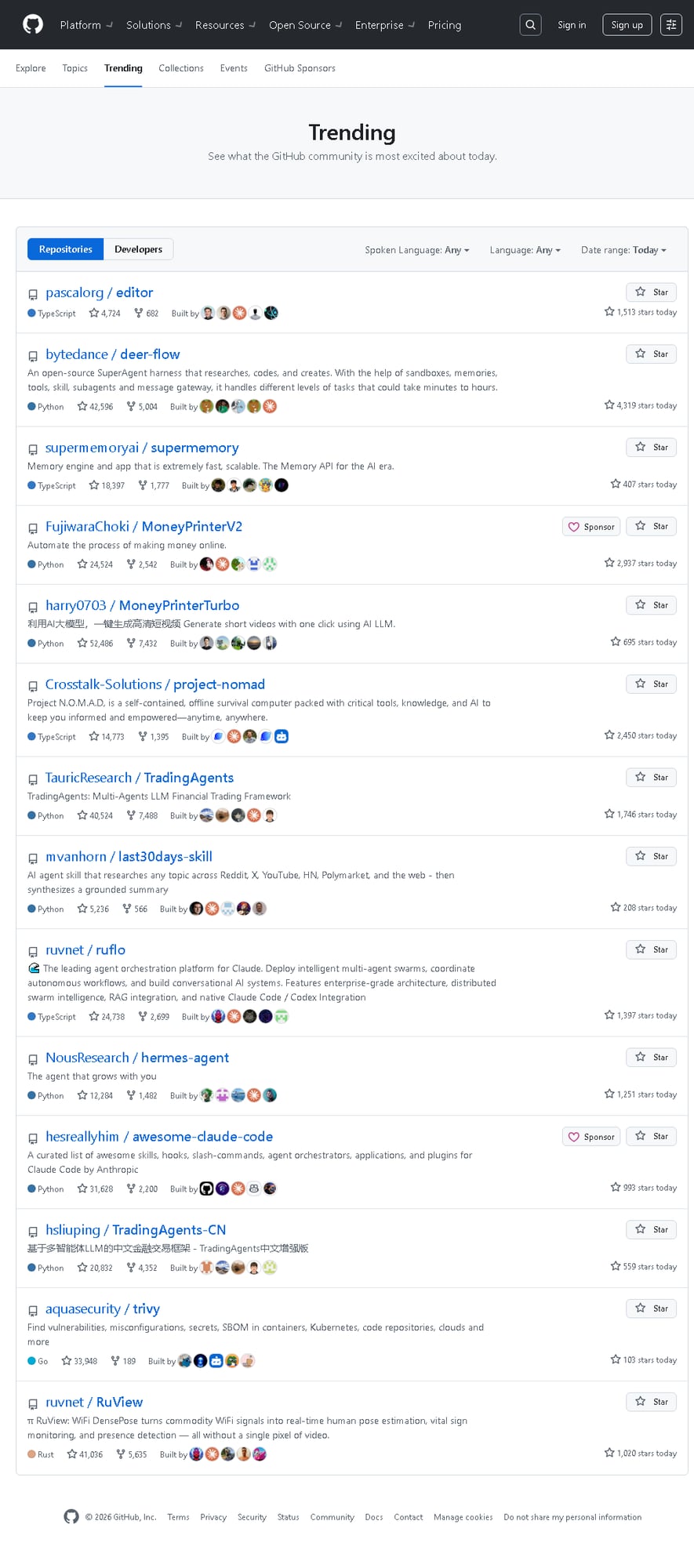
    ByteDance, the Chinese tech giant best known for TikTok, has released what may be one of the most ambitious open-source AI agent frameworks to date: DeerFlow 2.0. Since its launch, the project has accumulated over 42,000 stars on GitHub, with more than 4,300 stars earned in a single day — a growth trajectory that has the entire machine learning community buzzing.

    DeerFlow 2.0 is described as an “open-source SuperAgent harness.” But what does that actually mean? In practical terms, it’s a framework that orchestrates multiple AI sub-agents working together in sandboxes to autonomously complete complex, multi-hour tasks — from deep research reports to functional web pages to AI-generated videos.

    From Deep Research to Full-Stack Super Agent

    The original DeerFlow launched in May 2025 as a focused deep-research framework. Version 2.0 is a ground-up rewrite on LangGraph 1.0 and LangChain that shares no code with its predecessor. ByteDance explicitly framed the release as a transition “from a Deep Research agent into a full-stack Super Agent.”

    The key architectural difference is that DeerFlow is not just a thin wrapper around a large language model. While many AI tools give a model access to a search API and call it an agent, DeerFlow 2.0 gives its agents an actual isolated computer environment: a Docker sandbox with a persistent, mountable filesystem.

    The system maintains both short- and long-term memory that builds user profiles across sessions. It loads modular “skills” — discrete workflows — on demand to keep context windows manageable. And when a task is too large for one agent, a lead agent decomposes it, spawns parallel sub-agents with isolated contexts, executes code and bash commands safely, and synthesizes the results into a finished deliverable.

    Key Features That Set DeerFlow 2.0 Apart

    DeerFlow 2.0 ships with a remarkable set of capabilities:

    • Docker-based AIO Sandbox: Every agent runs inside an isolated container with its own browser, shell, and persistent filesystem. This ensures that the agent’s operations remain strictly contained, even when executing bash commands or manipulating files.
    • Model-Agnostic Design: The framework works with any OpenAI-compatible API. While many users opt for cloud-based inference via OpenAI or Anthropic APIs, DeerFlow supports fully localized setups through Ollama, making it ideal for organizations with strict data sovereignty requirements.
    • Progressive Skill Loading: Modular skills are loaded on demand to keep context windows manageable, allowing the system to handle long-horizon tasks without performance degradation.
    • Kubernetes Support: For enterprise deployments, DeerFlow supports distributed execution across a private Kubernetes cluster.
    • IM Channel Integration: The framework can connect to external messaging platforms like Slack or Telegram without requiring a public IP.

    Real-World Capabilities

    Demos on the project’s official website (deerflow.tech) showcase real outputs: agent-generated trend forecast reports, videos generated from literary prompts, comics explaining machine learning concepts, data analysis notebooks, and podcast summaries. The framework is designed for tasks that take minutes to hours to complete — the kind of work that currently requires a human analyst or a paid subscription to a specialized AI service.

    ByteDance specifically recommends using Doubao-Seed-2.0-Code, DeepSeek v3.2, and Kimi 2.5 to run DeerFlow, though the model-agnostic design means enterprises aren’t locked into any particular provider.

    Enterprise Readiness and the Safety Question

    One of the most pressing questions for enterprise adoption is safety and readiness. While the MIT license is enterprise-friendly, organizations need to evaluate whether DeerFlow 2.0 is production-ready for their specific use cases. The Docker sandbox provides functional isolation, but organizations with strict compliance requirements should carefully evaluate the deployment architecture.

    ByteDance offers a bifurcated deployment strategy: the core harness can run directly on a local machine, across a private Kubernetes cluster, or connect to external messaging platforms — all without requiring a public IP. This flexibility allows organizations to tailor the system to their specific security posture.

    The Open Source AI Agent Race

    DeerFlow 2.0 enters an increasingly crowded field. Its approach of combining sandboxed execution, memory management, and multi-agent orchestration is similar to what NanoClaw (an OpenClaw variant) is pursuing with its Docker-based enterprise sandbox offering. But DeerFlow’s permissive MIT license and the backing of a major tech company give it a unique position in the market.

    The framework’s rapid adoption — over 39,000 stars within a month of launch and 4,600 forks — signals strong community interest in production-grade open-source agent frameworks. For developers and enterprises looking to build sophisticated AI workflows without vendor lock-in, DeerFlow 2.0 is definitely worth watching.

    The project is available now on GitHub under the MIT License.