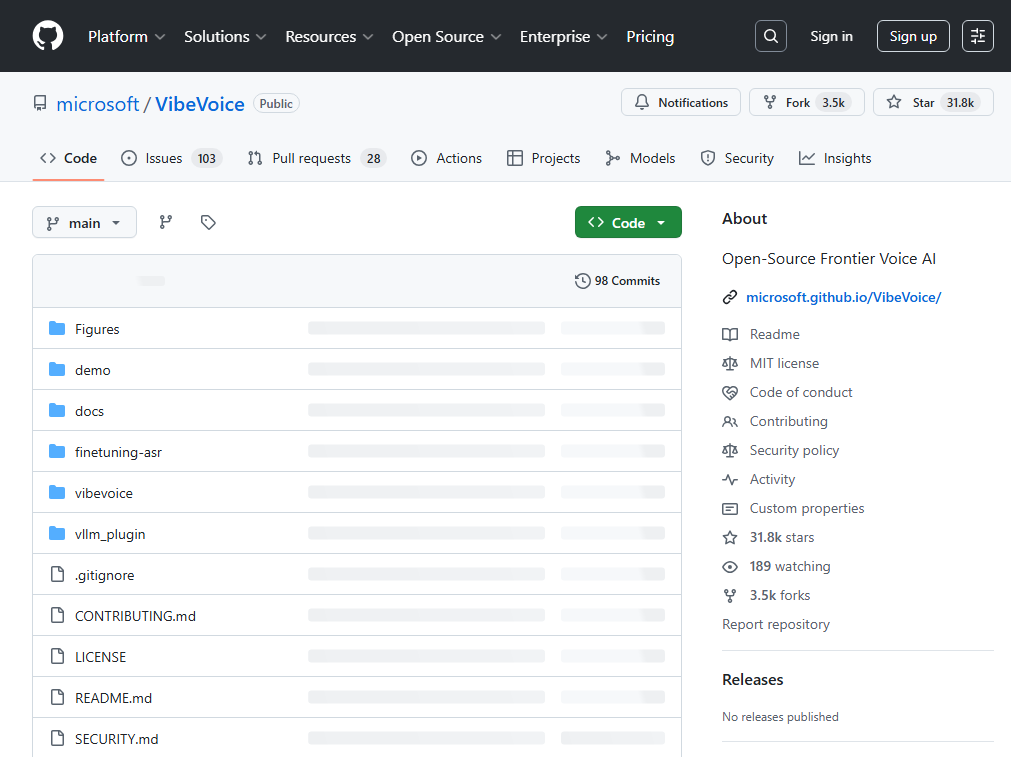
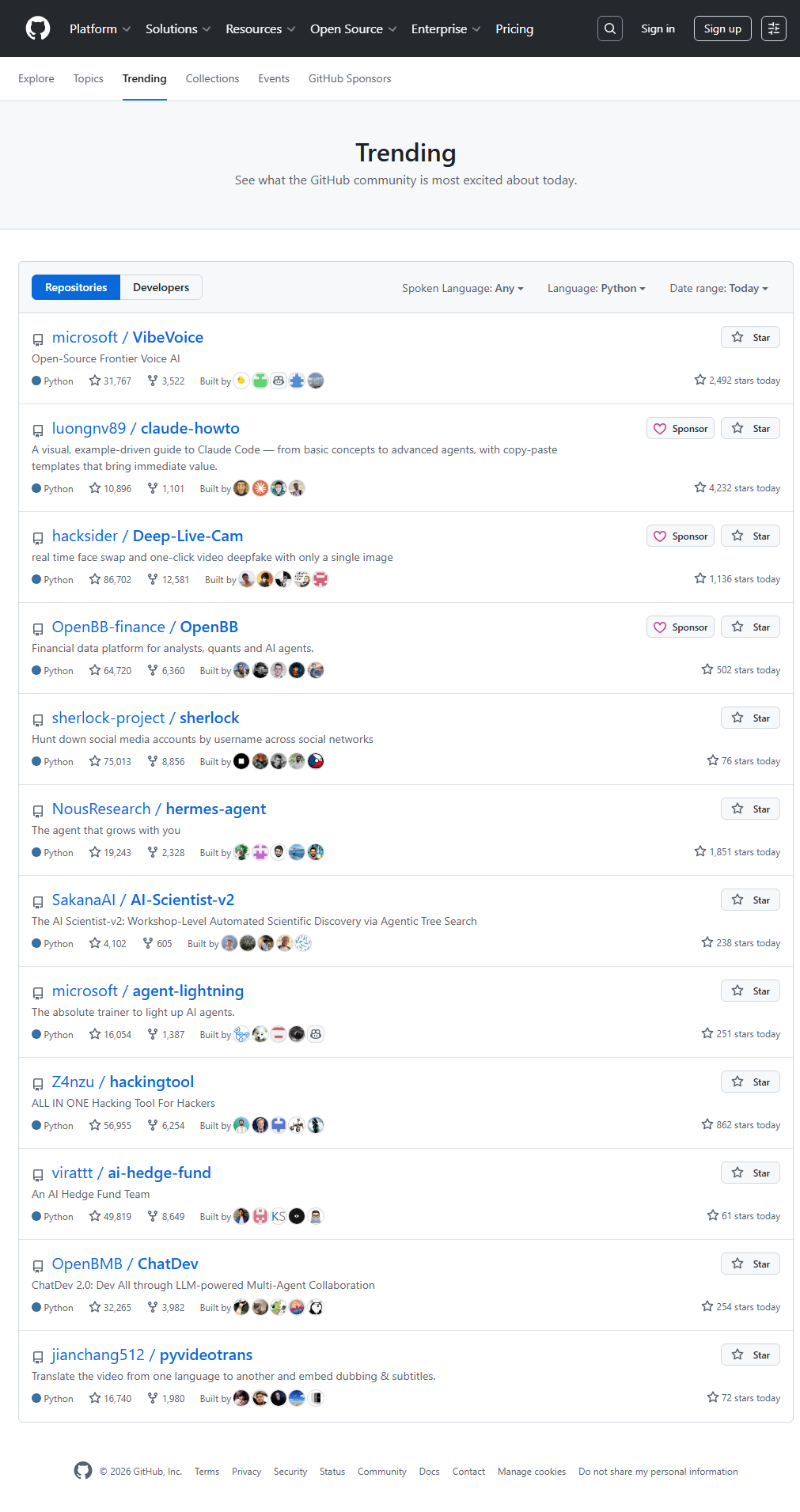
Microsoft’s VibeVoice has emerged as one of the most significant open-source voice AI releases of 2026, accumulating over 31,700 stars on GitHub with nearly 2,500 stars earned in a single day. This remarkable growth positions VibeVoice as a cornerstone project in the open-source speech AI ecosystem, offering capabilities that rival proprietary solutions while maintaining the accessibility and transparency that developers demand.
What is VibeVoice?
VibeVoice represents Microsoft’s ambitious entry into open-source frontier voice AI, encompassing both text-to-speech (TTS) and automatic speech recognition (ASR) technologies. The project family includes three distinct models: VibeVoice-ASR-7B for speech-to-text, VibeVoice-TTS-1.5B for long-form speech synthesis, and VibeVoice-Realtime-0.5B for streaming voice applications.
The core innovation driving VibeVoice lies in its revolutionary approach to processing audio. By employing continuous speech tokenizers operating at an ultra-low frame rate of 7.5 Hz, VibeVoice achieves remarkable computational efficiency while preserving audio fidelity. This design enables the system to process lengthy audio sequences that would overwhelm conventional approaches.
Revolutionary 60-Minute Audio Processing
Perhaps the most impressive capability of VibeVoice-ASR is its ability to process up to 60 minutes of continuous audio in a single pass. Traditional ASR systems typically fragment audio into short chunks, which frequently results in lost context and inconsistent speaker tracking. VibeVoice addresses this limitation by accepting entire audio segments within a 64K token window, ensuring coherent speaker diarization and semantic consistency across the full recording.
The system generates structured transcriptions that capture three critical dimensions: speaker identification (Who), timestamps (When), and content (What). This rich output format transforms raw audio into a highly usable, searchable document that preserves the conversational context analysts and researchers require.
Multilingual Excellence Across 50+ Languages
VibeVoice-ASR distinguishes itself through native multilingual support spanning over 50 languages. This global reach makes the system particularly valuable for international organizations, academic researchers studying cross-linguistic phenomena, and developers building applications for diverse user bases.
The model also supports customized hotwords, allowing users to inject domain-specific terminology, names, or contextual information to dramatically improve recognition accuracy for specialized content. This feature proves invaluable in medical, legal, technical, and academic contexts where standard language models frequently stumble.
The TTS Capabilities: 90-Minute Conversations
On the synthesis side, VibeVoice-TTS-1.5B synthesizes conversational speech up to 90 minutes long while maintaining speaker consistency and semantic coherence throughout. The system supports up to four distinct speakers within a single conversation, enabling natural turn-taking and preserving individual vocal characteristics across extended dialogues.
The model excels at expressive speech generation that captures conversational dynamics and emotional nuances, moving beyond the flat, robotic outputs that plagued earlier TTS systems. Cross-lingual capabilities allow the system to generate speech in languages different from the input text while preserving the speaker’s vocal identity.
Real-Time Voice Generation
VibeVoice-Realtime-0.5B represents a breakthrough in lightweight, streaming text-to-speech synthesis. With approximately 500 million parameters, this model achieves first-audio latency of around 300 milliseconds while generating speech at six times real-time speed. Its streaming text input capability makes it ideal for interactive applications where responsiveness determines user experience quality.
Integration and Accessibility
Microsoft has prioritized developer adoption by integrating VibeVoice-ASR directly into the Hugging Face Transformers library as of March 2026. This integration means developers can now access state-of-the-art speech recognition with a few lines of code, dramatically lowering the barrier to entry for incorporating advanced voice AI into applications.
The project provides comprehensive documentation, training scripts for customization, and pre-trained weights on Hugging Face. The vLLM inference support ensures efficient deployment in production environments where throughput and latency matter.
Industry Implications
VibeVoice’s emergence signals a significant shift in the voice AI landscape. By open-sourcing frontier-quality voice capabilities, Microsoft enables developers and organizations who cannot afford proprietary API costs or data privacy concerns to access cutting-edge technology. The project’s rapid adoption demonstrates that the open-source community can produce voice AI systems competitive with closed commercial offerings.
For enterprises, VibeVoice offers an alternative to vendors who control both models and data. Organizations can run VibeVoice entirely on-premises, maintaining complete sovereignty over sensitive audio information while benefiting from technology that continues to improve through community contributions.
Conclusion
Microsoft VibeVoice represents a landmark achievement in open-source voice AI development. Its combination of long-form processing capabilities, multilingual support, streaming performance, and tight framework integration creates a compelling offering for developers and organizations alike. As the project continues evolving with community contributions and Microsoft’s ongoing development, VibeVoice is positioned to remain at the forefront of accessible, high-quality voice AI technology.